
Retaining Walls on Shades Mountain: Vestavia Hills Slope Solutions
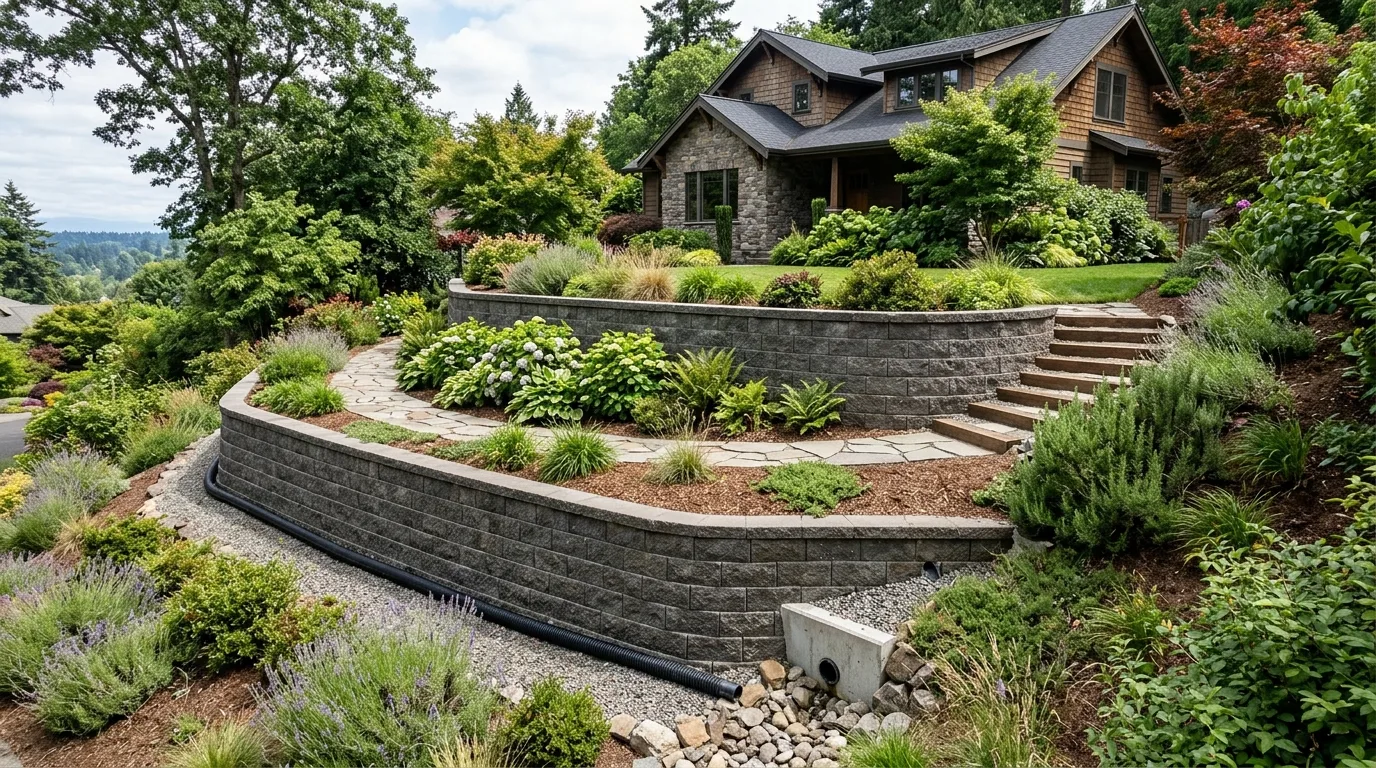
If your Vestavia Hills backyard is more slope than yard, you’re not alone. The city sits atop Shades Mountain at elevations up to 705 feet, and many lots in Rocky Ridge, Altadena Ridge, and the older sections along Shades Cahaba have grade changes that make usable outdoor space an engineering problem before it’s a landscaping one. Concrete retaining walls are the durable solution — but only when they’re engineered for the actual loads on a Vestavia Hills lot. In this post, we cover what makes Shades Mountain’s terrain uniquely demanding, what a properly engineered concrete retaining wall includes, and what to watch out for when getting estimates.
Free Retaining Wall Consultation in Vestavia Hills
We come to your lot and evaluate the slope — written estimates at no charge.
Why Shades Mountain Requires Engineered Concrete Retaining Walls
A retaining wall that works adequately on a flat Atlanta suburb lot can fail catastrophically on a Vestavia Hills hillside. The difference is in the forces acting on the wall. A concrete retaining wall must resist three types of pressure: the weight of the soil mass it’s retaining (static pressure), the additional force from a soil mass that’s on the verge of sliding down the slope (active soil pressure), and hydrostatic pressure from groundwater or saturated soil behind the wall.
Jefferson County’s clay soils amplify all three. Expansive clay is heavier when wet than sandy or loamy soils, and it generates significantly more lateral pressure against retaining wall faces when saturated. Vestavia Hills receives approximately 55 inches of annual rainfall — with March delivering nearly six inches in a single month. The combination of clay’s weight, its expansion when wet, and the hydrostatic pressure from groundwater behind poorly drained walls creates lateral forces that significantly exceed what the wall’s weight alone can resist.
Neighborhoods like Rocky Ridge and Altadena Park see this play out in timber retaining walls that fail within eight to ten years of installation — timber walls that weren’t engineered for Alabama’s clay-soil hydrostatic loads and lacked adequate drainage systems to relieve that pressure. Concrete retaining walls built without drainage fail for the same reason: regardless of material, the wall has to drain or it will fall.
What a Properly Engineered Concrete Retaining Wall Includes
Footing below the frost line: Concrete retaining walls require a reinforced concrete footing at sufficient depth to prevent frost heaving (rare in Vestavia Hills but relevant for design) and to distribute the wall’s load on stable soil. The footing is typically poured and cured before wall construction begins.
Rebar reinforcement at engineered spacing: The rebar pattern in a concrete retaining wall isn’t arbitrary — it’s determined by the wall height, soil pressure, and footing geometry. Taller walls and steeper slopes require closer rebar spacing and larger bar diameters. A wall designed for a 3-foot height should not be built taller than designed without recalculating the reinforcement.
Drainage aggregate behind the wall: A layer of crushed stone (typically 6–12 inches thick) between the retained soil and the back face of the wall allows water to drain freely through the wall system rather than building hydrostatic pressure against the wall face. This is the most commonly omitted element in retaining wall failures in Jefferson County — walls look structurally sound but fall because of water pressure that drainage would have eliminated.
Weep holes at the base of the wall: Openings at regular horizontal spacing at the base of the wall allow water from the drainage aggregate to exit the wall system. Weep holes must be present and unobstructed to function. A beautiful concrete retaining wall with no weep holes is a wall that will fail under sustained rainfall.
Compacted backfill in lifts: Soil backfilled behind a retaining wall must be placed in compacted lifts — not dumped and left to settle. Improperly compacted backfill settles unevenly, creating uneven soil pressure distribution and often drainage voids that allow water to percolate directly to the wall base.
Types of Concrete Retaining Walls for Vestavia Hills Slopes
Poured concrete gravity wall: Uses the mass of the concrete itself to resist soil pressure without deep footings. Appropriate for lower walls (under 3 feet) where the concrete mass is sufficient. Simple to build but limited in height.
Poured concrete cantilever wall: The most common structural concrete retaining wall for Vestavia Hills applications. A reinforced concrete stem wall extends from a footing below grade — the footing’s length distributes the overturning force from soil pressure across a wide base. Appropriate for walls from 3 to 20 feet.
Concrete block (CMU) wall: Concrete masonry units with grouted and reinforced cores. Less common for structural retaining walls than poured concrete but appropriate in some applications. Requires the same drainage system behind the wall.
Segmental retaining wall: Precast concrete blocks stacked without mortar, with geogrid reinforcement extending into the retained soil. Common in landscape applications. Not appropriate for walls over 3–4 feet on Vestavia Hills’ clay-soil slopes without engineering review.
Concrete Retaining Walls Built for Vestavia Hills' Shades Mountain Terrain
Engineering, drainage, and construction from a contractor who knows Jefferson County's clay soils.
Cost Guide for Retaining Walls in Vestavia Hills
Retaining wall costs in Vestavia Hills vary more than almost any other concrete project because height, site access, and drainage requirements are so site-specific. General ranges:
- Under 3 feet, simple site access: $25–$40 per linear foot. Garden-level walls on accessible lots.
- 3–6 feet, standard residential lot: $45–$80 per linear foot. The most common structural retaining wall height in Vestavia Hills, including full drainage system.
- 6–12 feet on steep Shades Mountain slope: $80–$120+ per linear foot. Taller walls require heavier reinforcement, larger footings, more drainage aggregate, and may require engineer-stamped drawings and Vestavia Hills permit.
- Multi-tier wall systems: Terraced walls that create multiple level areas require engineering for each tier’s interaction with the ones above and below it. Priced by total project scope.
Frequently Asked Questions
Does a concrete retaining wall need a permit in Vestavia Hills?
Retaining walls over approximately 30 inches above grade require a City of Vestavia Hills permit. Taller walls or walls adjacent to structures, property lines, or drainage easements may require engineer-stamped drawings as part of the permit application. We evaluate permit requirements for your specific wall during the estimate and handle the application process. Building without a required permit creates compliance risk and potential liability if the wall causes property damage.
How long will a concrete retaining wall last in Alabama?
A properly engineered concrete retaining wall with adequate drainage in Alabama lasts 50+ years. The main variable is drainage — walls with functioning weep holes and drainage aggregate behind them withstand Jefferson County’s clay soil pressure and heavy spring rains indefinitely. Walls without drainage fail in 5–15 years as hydrostatic pressure builds. Never accept a retaining wall proposal that doesn’t include a specified drainage system.
Can an existing failing retaining wall be repaired?
Some failing retaining walls can be repaired; others require replacement. A wall that has tilted but not failed can sometimes be reinforced with deadmen anchors or soil nails if the concrete itself is sound. A wall that has cracked, buckled, or toppled typically requires full replacement. The drainage system behind a repaired or replaced wall must be corrected as part of any repair — adding drainage to an existing wall is difficult but sometimes possible through installation of drainage channels and weep holes.
Vestavia Hills Retaining Walls — Engineered for Shades Mountain
Call (888) 376-0955 for a free site evaluation. Structural walls with proper drainage for Jefferson County's demanding terrain.
Related: