
Vestavia Hills Clay Soil Requires Special Concrete Foundations
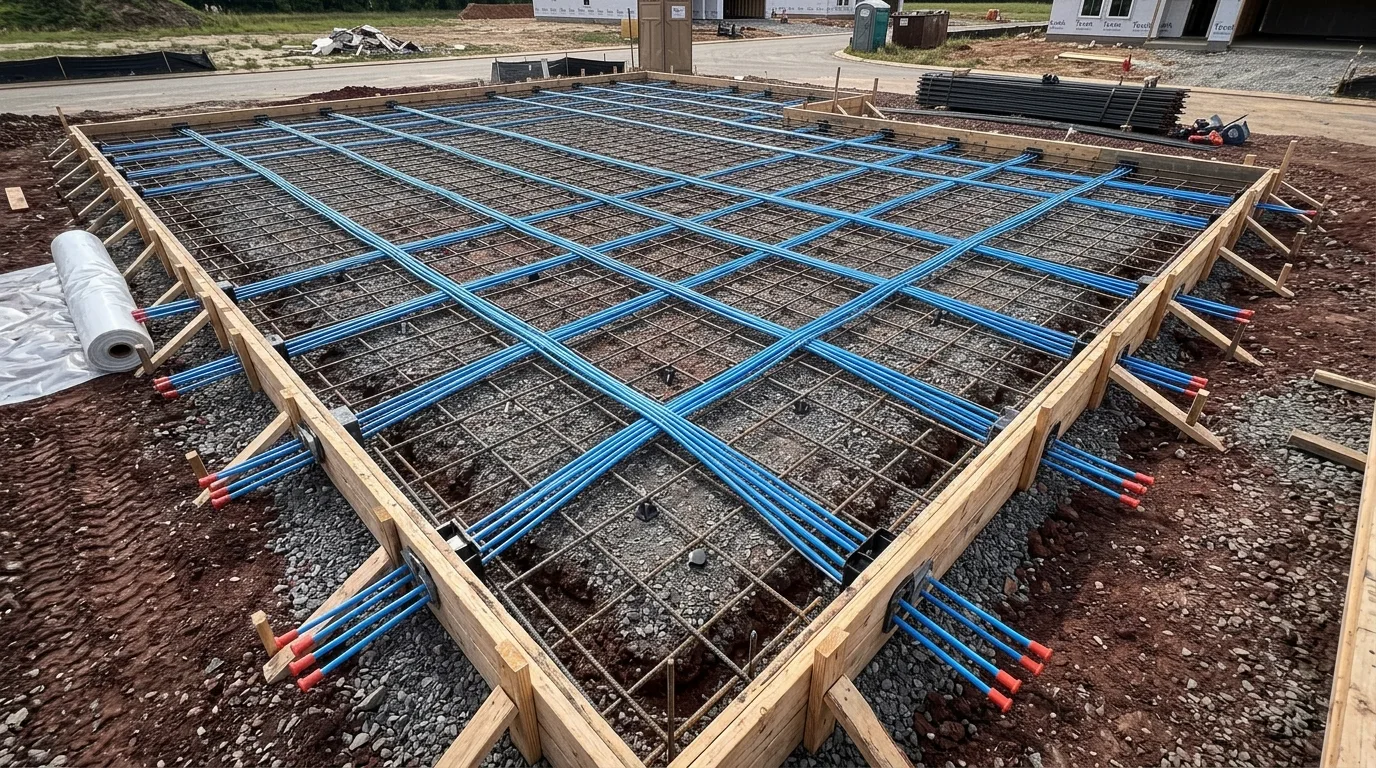
Vestavia Hills homeowners who notice sticking doors, diagonal cracks in drywall, or gaps at the ceiling line are usually seeing the symptoms of a foundation that’s responding to something happening beneath it. In Jefferson County, that something is almost always the same: expansive clay soil doing what it does every year. In this post, we cover what makes Vestavia Hills’ soil conditions unique, how concrete foundation design accounts for it, and what the difference between a standard slab and a post-tensioned slab means for your home.
Foundation Questions in Vestavia Hills?
Get a free concrete foundation evaluation — we assess your site and explain your options honestly.
Why Clay Soil Concrete Foundation Issues Matter in Vestavia Hills
Jefferson County’s soils contain a high proportion of expansive clay minerals — clay that absorbs water molecules and expands in volume when wet, then contracts and pulls away from adjacent structures when dry. Vestavia Hills receives approximately 55 inches of annual rainfall, with March delivering nearly six inches alone. After the wet season, Alabama’s summer dry period causes the same clay to shrink significantly. This expansion-contraction cycle repeats every year, placing upward, downward, and lateral pressure on any concrete foundation that’s in contact with native clay soils.
The magnitude of this movement depends on several factors: the specific clay mineral composition on your lot (which varies across Vestavia Hills neighborhoods like Cahaba Heights and Altadena Park), the depth to groundwater, and whether the lot has effective drainage directing water away from the foundation perimeter. A foundation installed on well-managed clay with proper drainage moves far less than one in contact with poorly drained, repeatedly saturated clay.
The Alabama Building Code (IBC 2021) Chapter 18 recognizes this — it includes specific provisions for foundation design in expansive soil conditions. The permit and inspection process through the City of Vestavia Hills Building Safety department enforces these requirements for a reason.
Types of Concrete Foundations for Vestavia Hills Clay Soils
Standard slab-on-grade with rebar: The minimum-spec residential foundation. Concrete poured directly on a prepared sub-base with rebar grid reinforcement. Acceptable in areas with stable, non-expansive soils — but standard rebar reinforcement doesn’t prevent clay-induced slab cracking. It controls crack width and maintains structural connection if cracking occurs. On active clay soils, this type of slab will crack over time.
Post-tensioned slab: The preferred foundation type for Jefferson County’s clay soil conditions. Steel tendons (cables) are embedded in the concrete slab before the pour, then tensioned after the concrete reaches initial strength using hydraulic jacks. The tension in the cables puts the slab under compression — which allows it to flex slightly as the soil moves beneath it rather than cracking at a stress concentration point. Post-tensioned slabs are significantly more crack-resistant than standard rebar slabs on expansive clay soils.
Drilled pier and grade beam: For lots with particularly deep or active clay, drilled piers can extend below the zone of seasonal moisture change to stable soil beneath. A concrete grade beam ties the piers together and supports the structure above the active clay layer. This approach is more expensive but appropriate for the most challenging Shades Mountain lot conditions.
Stem wall foundation: A concrete perimeter wall supporting a crawl space rather than a slab on grade. Less common in Vestavia Hills’ modern construction but found in older homes throughout Altadena Park and other established neighborhoods. Stem walls can be affected by clay pressure differently than slabs — drainage around the perimeter is particularly critical.
Practical Uses and Site-Specific Considerations
- New home construction on Vestavia Hills lots: A post-tensioned slab is the standard recommendation from structural engineers working in Jefferson County. The cost premium over standard rebar is $1–$3 per square foot — a small addition to a foundation that protects decades of investment.
- Detached garages and workshops: Standard slab foundations on well-prepared sub-bases work for accessory structures on stable portions of Vestavia Hills lots. Clay drainage management remains critical even for smaller structures.
- Room additions tied to existing slabs: New foundation sections must be properly tied into the existing foundation to prevent differential movement between old and new sections. Post-tension anchors can sometimes be added to tie the sections together.
- Foundation repair for existing homes: Settled or cracked foundations in older Vestavia Hills homes often reflect inadequate original sub-base preparation or drainage failures. Remediation options range from underpinning to drainage correction — evaluated site by site.
How Proper Foundation Design Prevents Problems
The foundation design process for a Vestavia Hills home on clay soils starts with understanding the clay’s behavior on that specific lot. Sub-base preparation removes the most active clay from the bearing zone and replaces it with compacted gravel or engineered fill that provides stable, non-expansive support for the slab. Drainage design directs surface and subsurface water away from the foundation perimeter at all points, reducing the moisture cycling that drives clay expansion.
Post-tensioning adds the mechanical flexibility that allows the slab to handle any remaining soil movement without brittle cracking. The tensioned cables distribute stress across the full slab area rather than concentrating it at a single crack point. In the Birmingham metro area — including Vestavia Hills, Hoover, and Homewood — post-tensioned slabs have become the de facto standard for new residential construction on clay-heavy lots for exactly this reason.
Planning a Concrete Foundation in Vestavia Hills?
Talk to us about your lot and soil conditions — we'll recommend the right foundation type for your specific site.
Frequently Asked Questions
How do I know if my Vestavia Hills lot has active clay soils?
Virtually all lots in Vestavia Hills sit on some degree of expansive clay. The intensity varies by neighborhood and specific site conditions. Signs of active clay movement include doors that stick seasonally (tighter in wet weather, looser in dry), diagonal cracks in drywall originating from door corners, and gaps between the home’s floor and interior walls. A site visit from a concrete contractor or structural engineer who works in Jefferson County can assess your specific lot conditions.
What does a post-tensioned slab cost in Vestavia Hills?
Post-tensioned slabs add approximately $1–$3 per square foot over standard rebar slab costs, which start at $5–$10 per square foot for the concrete foundation work itself. For a 1,500 sq ft home foundation, the post-tension premium runs $1,500–$4,500 — a small percentage of total construction cost for significantly improved clay-soil performance. We provide concrete foundation estimates that distinguish between standard and post-tensioned options so you can evaluate the cost-benefit for your specific project.
Can an existing slab be retrofitted for better performance on clay soils?
In some cases, yes. Post-tension anchors can be installed in an existing slab perimeter to add compression. Drainage corrections around the foundation perimeter can significantly reduce the moisture cycling that drives clay movement. Underpinning with drilled piers can stabilize a settled slab on lots with particularly deep active clay. The right approach depends on the specific failure mode and site conditions.
Vestavia Hills Concrete Foundation Experts
Call (888) 376-0955 for a free foundation consultation. Post-tensioned and slab-on-grade options engineered for Jefferson County clay soils.
Related: