
5 Signs Your Vestavia Hills Concrete Driveway Needs Replacement
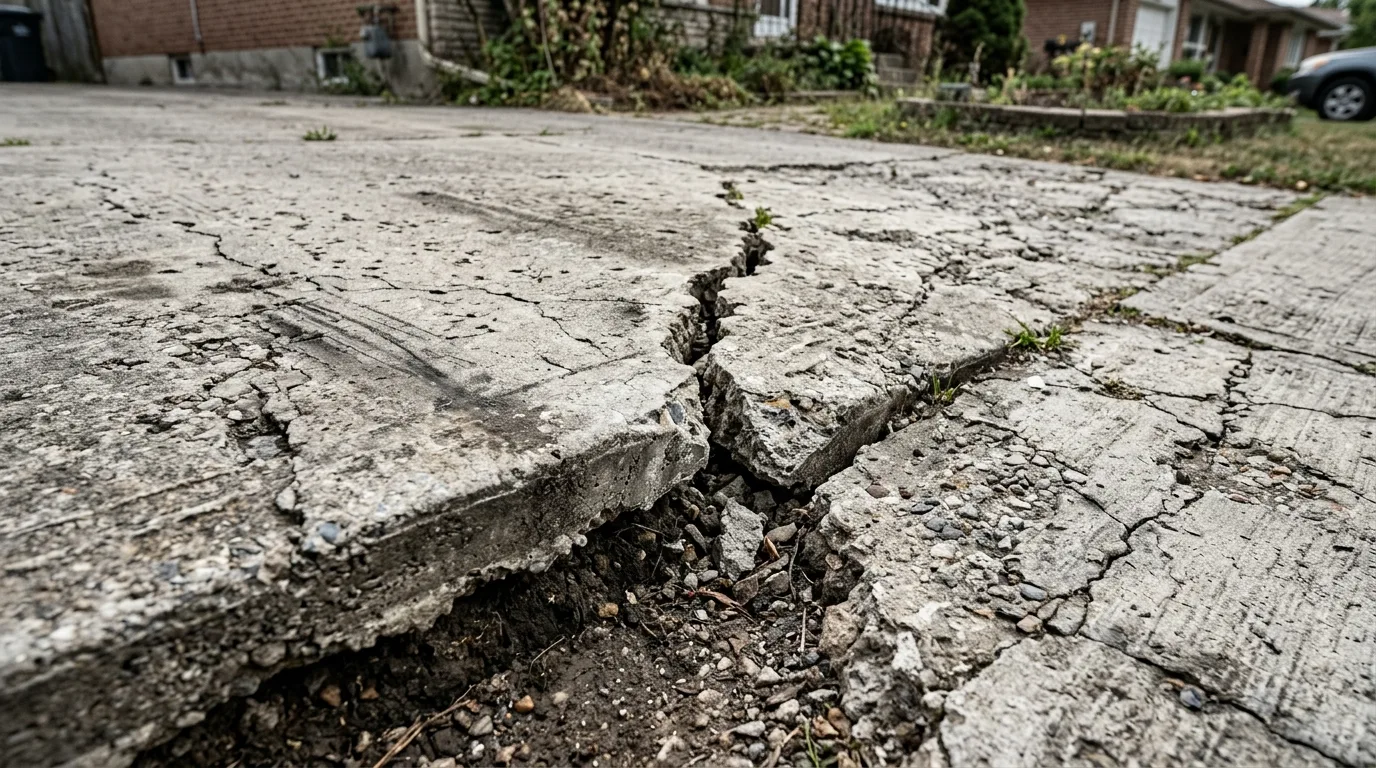
Not every cracked driveway needs replacement, and not every old driveway deserves expensive repairs. The question homeowners in Vestavia Hills ask most often is: “Should I repair this or replace it?” The answer depends on five specific indicators — and getting the diagnosis right can save thousands of dollars in either direction. Here’s how to assess your concrete driveway honestly before calling a contractor.
Free Concrete Repair vs. Replacement Assessment in Vestavia Hills
We'll evaluate your driveway honestly — no pressure toward the more expensive option.
Why Vestavia Hills Driveways Age the Way They Do
Before we get into the signs, it helps to understand what drives concrete driveway deterioration in Vestavia Hills specifically. Jefferson County’s expansive clay soils place upward and downward pressure on driveways as the clay expands with spring rainfall and contracts during summer dry periods. Driveways installed without adequate sub-base preparation — or driveways from the 1980s and 1990s when fiber-mesh reinforcement wasn’t standard — have been absorbing this movement for years.
Alabama’s UV intensity degrades unsealed concrete surfaces significantly faster than in northern climates. A concrete driveway that’s never been sealed shows surface scaling and pitting within five to ten years. Add the thermal expansion from Vestavia Hills’ summer heat and the occasional freeze in Cahaba Heights during Alabama winters, and most concrete driveways are showing some level of wear by the time they reach 15–20 years of age.
The question is which wear patterns indicate concrete flatwork at the end of its structural life vs. wear patterns that a concrete repair can genuinely address.
Sign 1: Cracks Covering More Than 25% of the Surface
A few isolated cracks don’t indicate driveway failure — they’re a normal part of concrete’s long-term behavior as it responds to temperature changes and minor soil movement. The threshold that indicates broader structural failure is when cracking has become widespread: multiple interconnected cracks, alligator cracking (a network of cracks resembling an alligator’s back), or cracking that spans full driveway sections in multiple places.
Widespread cracking in a Vestavia Hills driveway typically indicates that the sub-base beneath the slab has been compromised — either never adequate to begin with, or eroded by years of water infiltration through existing cracks. When the sub-base fails, no amount of crack filling will restore structural integrity. The cracks will reopen quickly because the cause — lack of support beneath the slab — hasn’t been addressed. Replacement with a proper sub-base is the only durable solution.
Sign 2: Settlement Greater Than an Inch
When a concrete slab section drops more than one inch below adjacent sections, it indicates that the soil beneath it has compacted, eroded, or contracted significantly. In Vestavia Hills, this most often happens where drainage has failed: water infiltrating under the slab saturates and erodes the clay sub-base, which settles unevenly as it dries.
A one-inch or greater height differential between slab sections creates trip hazards, garage door clearance problems, and drainage issues that direct water toward the garage or home foundation. Mudjacking (pumping material beneath the slab to lift it) can work for minor settlement on a structurally sound slab. But when settlement is severe or when the concrete above the settled area has cracked through the full depth, replacement is the more cost-effective long-term answer. Concrete repair doesn’t change the sub-base conditions that caused the settlement.
Sign 3: Full-Depth Cracks at Multiple Joints
Expansion joints are intentional weak points built into concrete driveways to control where cracking occurs as the slab expands and contracts. When the joints function correctly, cracks form at the joints rather than randomly through the slab surface. When joints have failed — filled with debris, deformed, or simply absent in older driveways — cracking migrates through the slab body rather than to controlled locations.
Full-depth cracks (cracks that go all the way through the concrete slab thickness, not just surface cracks) at multiple locations indicate that the slab can no longer function as a structural unit. Sections are moving independently, which means water is entering through every full-depth crack, saturating the sub-base below. A concrete driveway with multiple full-depth cracks at non-joint locations throughout its length has reached the end of its service life.
Sign 4: Drainage That Directs Water Toward the Garage or Home
This sign can be present on a driveway that looks surface-intact. If standing water pools near the garage entry or flows toward the home’s foundation after Vestavia Hills’ spring rains, the driveway grade has either failed or was never correctly installed. A concrete driveway that drains toward rather than away from structures is actively damaging the foundation every time it rains.
Is Your Vestavia Hills Driveway Draining Toward Your Home?
We assess drainage performance as part of every free estimate — it matters more than surface appearance.
Correcting drainage slope requires replacement, not repair. The only way to change a slab’s drainage direction is to remove it and re-pour with correct elevation and slope. Some homeowners attempt surface-applied drainage channels as a workaround, but these rarely solve the underlying problem on Jefferson County’s clay-soil lots. If your Liberty Park or Vestavia club estates driveway is sending water toward your foundation, replacement with correct grade design is the priority fix.
Sign 5: Age Over 30 Years with Widespread Surface Scaling
Concrete driveways in Vestavia Hills installed before 1996 — when fiber-mesh reinforcement became more standard in residential concrete flatwork — typically used wire mesh or rebar grid reinforcement that has had 30+ years to work against the clay soil movement beneath it. Combine that age with decades of Alabama UV exposure, and most of these driveways show significant surface scaling: the top layer of concrete has separated from the body of the slab in sheets or patches, exposing the aggregate underneath.
Surface scaling on an aged slab can sometimes be addressed with resurfacing overlay — but only if the slab beneath is still structurally sound and reasonably level. Resurfacing a badly deteriorated or settled slab is a temporary fix. The scaling will recur as the overlay fails at the same points where the base slab is deteriorating. For driveways over 30 years old with widespread scaling and any of the above signs, replacement is almost always the better investment.
Frequently Asked Questions
How do I know if mudjacking will work for my Vestavia Hills driveway?
Mudjacking is effective when: individual slab sections have settled uniformly (not cracked through), the concrete above the settled area is still structurally intact, and the settlement was caused by soil compaction that hasn’t continued significantly. If the concrete is cracked through, or if the settlement continues to worsen over time (indicating ongoing clay soil movement), mudjacking is a temporary solution. We assess whether your driveway is a good mudjacking candidate during the free estimate visit.
Can concrete resurfacing extend the life of a failing Vestavia Hills driveway?
Concrete resurfacing adds a thin overlay to an existing slab. It works well when the slab beneath is structurally sound — no full-depth cracks, minimal settlement, good drainage — and the issue is purely surface deterioration (scaling, surface pitting, appearance). It does not address structural problems, drainage failure, or sub-base issues. A resurfaced driveway with structural problems will show those problems through the overlay within two to three years.
What should a concrete driveway replacement cost in Vestavia Hills?
Concrete driveway replacement in Vestavia Hills runs $5,851–$7,580 for a standard 600 sq ft two-car driveway, or $6–$12 per square foot installed. This includes demo and haul-off of the old concrete, sub-base preparation with compacted gravel, and new concrete pour with proper reinforcement and sealing. Get three written estimates that each specify sub-base depth, concrete thickness, and reinforcement type before making a decision.
Free Driveway Assessment in Vestavia Hills
Call (888) 376-0955 — we'll tell you honestly whether repair or replacement is the right answer for your driveway.
Related: