
Concrete Sidewalk Repair: Maintaining Vestavia Hills Curb Appeal
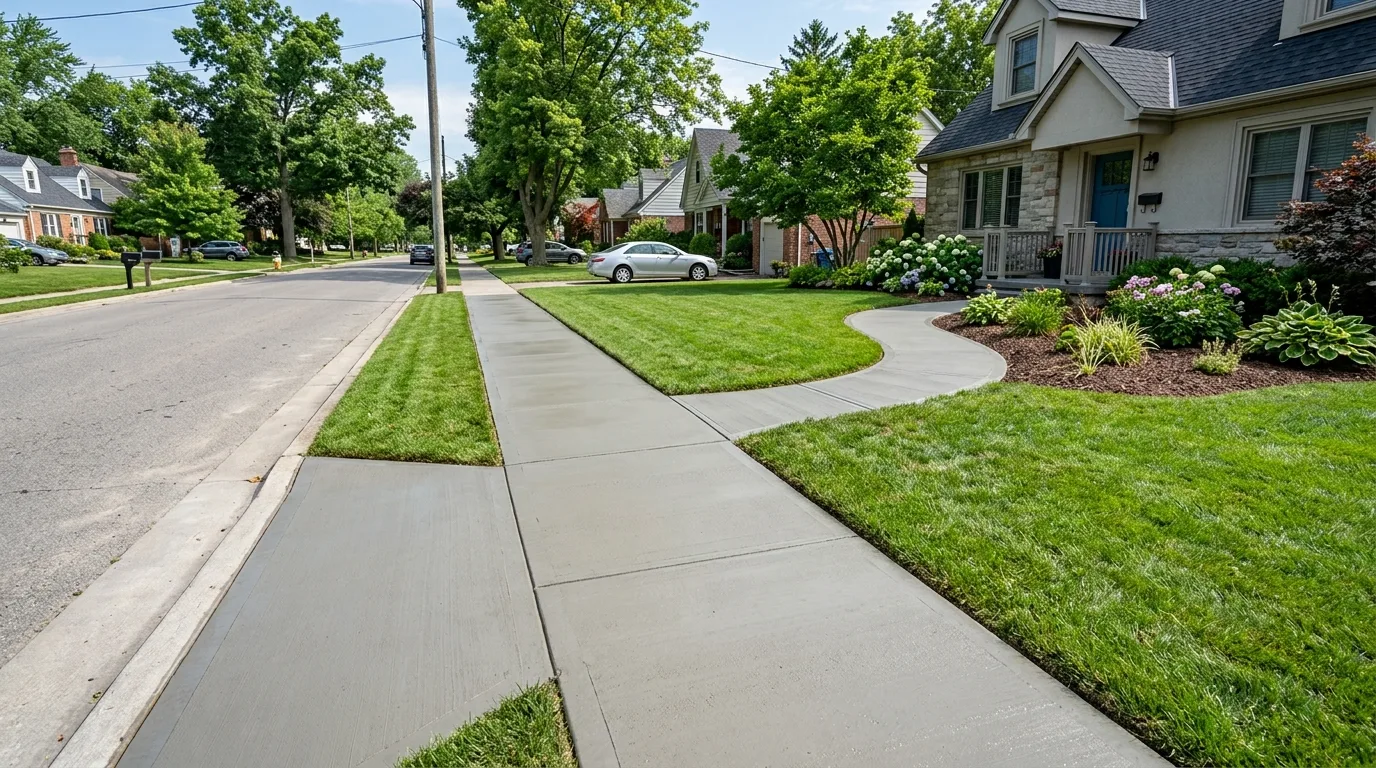
A cracked or settled concrete sidewalk in Vestavia Hills isn’t just an eyesore — it’s a trip hazard and a liability risk. Whether it’s a public sidewalk damaged by tree root intrusion in Altadena Park or a private entry walkway that’s settled on clay soils in Cahaba Heights, the repair approach matters as much as the cosmetic result. In this post, we cover what causes concrete sidewalk damage in Vestavia Hills, the repair options available, and when replacement makes more sense than patching.
Concrete Sidewalk Repair in Vestavia Hills — Free Assessment
We assess your sidewalk damage and tell you what will hold and what won't.
Why Concrete Sidewalks Fail in Vestavia Hills
Sidewalk damage in Vestavia Hills follows predictable patterns tied to Jefferson County’s specific conditions. Tree root intrusion is the most visible cause: established trees in Altadena Park’s older neighborhoods have root systems that grow beneath concrete sidewalk slabs and lift them from below, creating abrupt elevation changes that are both unsightly and dangerous. Root damage typically breaks the slab — once a tree root has lifted a section, the concrete has cracked through and the root will continue growing.
Jefferson County’s clay soils create settlement damage independent of tree roots. Seasonal moisture cycling expands and contracts the clay beneath sidewalk slabs, causing sections to move vertically at different rates. A sidewalk installed without adequate gravel sub-base on Vestavia Hills’ clay terrain typically shows its first significant settlement within five to eight years — small grade changes that grow over time.
Alabama’s UV exposure without regular sealing causes surface scaling on sidewalk concrete. The top layer of the cement paste degrades and flakes away, creating rough, deteriorating surface texture that looks bad, holds dirt, and eventually compromises the structural integrity of thin sections.
Sidewalk Repair Options for Vestavia Hills
Mudjacking and slab lifting: For sidewalk sections that have settled without cracking through, slab lifting (mudjacking or polyurethane foam injection) can restore level surface with minimal disruption. Holes drilled in the slab allow material to be pumped beneath it, lifting the settled section back to grade. Effective when the concrete is still structurally sound and the settlement was caused by soil compaction rather than active ongoing movement.
Grinding: When two adjacent sidewalk sections have an elevation difference of less than one inch, grinding — mechanically reducing the height of the higher section to create a flush transition — can eliminate trip hazards without replacement. Grinding is a temporary solution for sections with minor offset; it doesn’t address the underlying cause.
Partial replacement: Individual settled or cracked sections of a concrete sidewalk can be removed and replaced while leaving intact adjacent sections. The challenge is color matching — new concrete poured next to old concrete will not initially match in appearance. Over time, weathering brings the colors closer together, but the difference can be noticeable for months to years. Partial replacement is cost-effective when only one or two sections have failed.
Full replacement: When sidewalk damage is widespread, when tree roots require removal or rerouting before concrete can be replaced, or when the existing concrete was installed without adequate sub-base, full replacement with a proper sub-base delivers the best long-term result. Full replacement costs more upfront but eliminates the pattern of repeated partial repairs.
Concrete resurfacing: A bonded overlay applied over an existing sidewalk slab can restore surface appearance when the underlying concrete is structurally sound. Resurfacing addresses scaling and surface wear — it does not address cracks or settlement. An appropriate solution for aesthetics-only issues on otherwise sound concrete flatwork.
Public vs. Private Sidewalks in Vestavia Hills
Responsibility for sidewalk maintenance in Vestavia Hills depends on whether the sidewalk is within the public right-of-way or on private property. Public sidewalks in the right-of-way are technically the city’s responsibility, but in practice, maintenance often falls to adjacent property owners by local ordinance. Check with the City of Vestavia Hills Public Works department to understand responsibility for sidewalks adjacent to your property before investing in repairs.
Private sidewalks — entry walkways, garden paths, and concrete flatwork entirely on private property — are entirely the homeowner’s responsibility. These require the same permit consideration as other concrete construction; check permit requirements with the City Building Safety department for any significant replacement work.
Vestavia Hills Sidewalk Repair — Professional Concrete Flatwork
We handle both private and HOA-adjacent sidewalk repair and replacement in Vestavia Hills and Jefferson County.
Cost Ranges for Sidewalk Work in Vestavia Hills
Mudjacking/slab lifting: $500–$1,500 for a residential sidewalk section. Most cost-effective when multiple adjacent sections can be lifted in a single visit.
Partial sidewalk section replacement: $15–$25 per square foot for individual section removal and new concrete pour. A 4-foot x 4-foot section runs $240–$400 for the concrete flatwork; demo and disposal add to the total.
Full sidewalk replacement: $8–$15 per square foot for full sidewalk removal and replacement with proper sub-base preparation. A 40 linear foot by 4 foot sidewalk (160 sq ft) runs $1,280–$2,400.
Grinding: $50–$150 per linear foot of offset crack, depending on the extent of grinding required.
Practical Tips for Vestavia Hills Sidewalk Projects
- Address tree root issues before replacing concrete. If tree roots caused the damage, replacing the concrete without managing the roots is a short-term fix. Root barriers, root pruning, or in some cases tree removal should precede replacement.
- Maintain proper drainage slope. Concrete sidewalks should slope away from structures at a minimum 1% grade. Improper slope directs water toward home foundations and accelerates sub-base saturation on Jefferson County’s clay soils.
- Seal new concrete in year one. New sidewalk concrete in Vestavia Hills benefits from penetrating sealer applied after the initial cure period — typically 28 days. Sealing prevents UV degradation and staining that accelerate surface deterioration.
Frequently Asked Questions
Who is responsible for sidewalk repairs in Vestavia Hills?
Public sidewalks within the city’s right-of-way may be the city’s responsibility or the adjacent property owner’s — verify with the City of Vestavia Hills Public Works department. Private sidewalks on your property are your responsibility. We can help you understand the distinction for your specific location and advise on the best repair approach.
How much does concrete sidewalk replacement cost in Vestavia Hills?
Partial section replacement runs $15–$25 per square foot for the concrete work itself. Full sidewalk replacement with proper sub-base runs $8–$15 per square foot including demo and disposal. Sub-base requirements on Jefferson County’s clay soils may add to the total. We provide free written estimates based on your specific sidewalk dimensions and site conditions.
Can tree roots be managed without removing the tree?
Sometimes. Root barriers installed during sidewalk replacement can redirect root growth away from the concrete. Root pruning (selectively removing roots that have grown beneath the slab) combined with proper sub-base and concrete joint design can extend the life of new concrete adjacent to existing trees. The feasibility depends on the tree species, root system maturity, and proximity to the sidewalk. We assess root situations during the estimate visit.
Vestavia Hills Concrete Sidewalk Service
Call (888) 376-0955 for a free assessment of your sidewalk damage and a written estimate for repair or replacement.
Related: