
Winter Concrete Pouring in Alabama: What You Need to Know
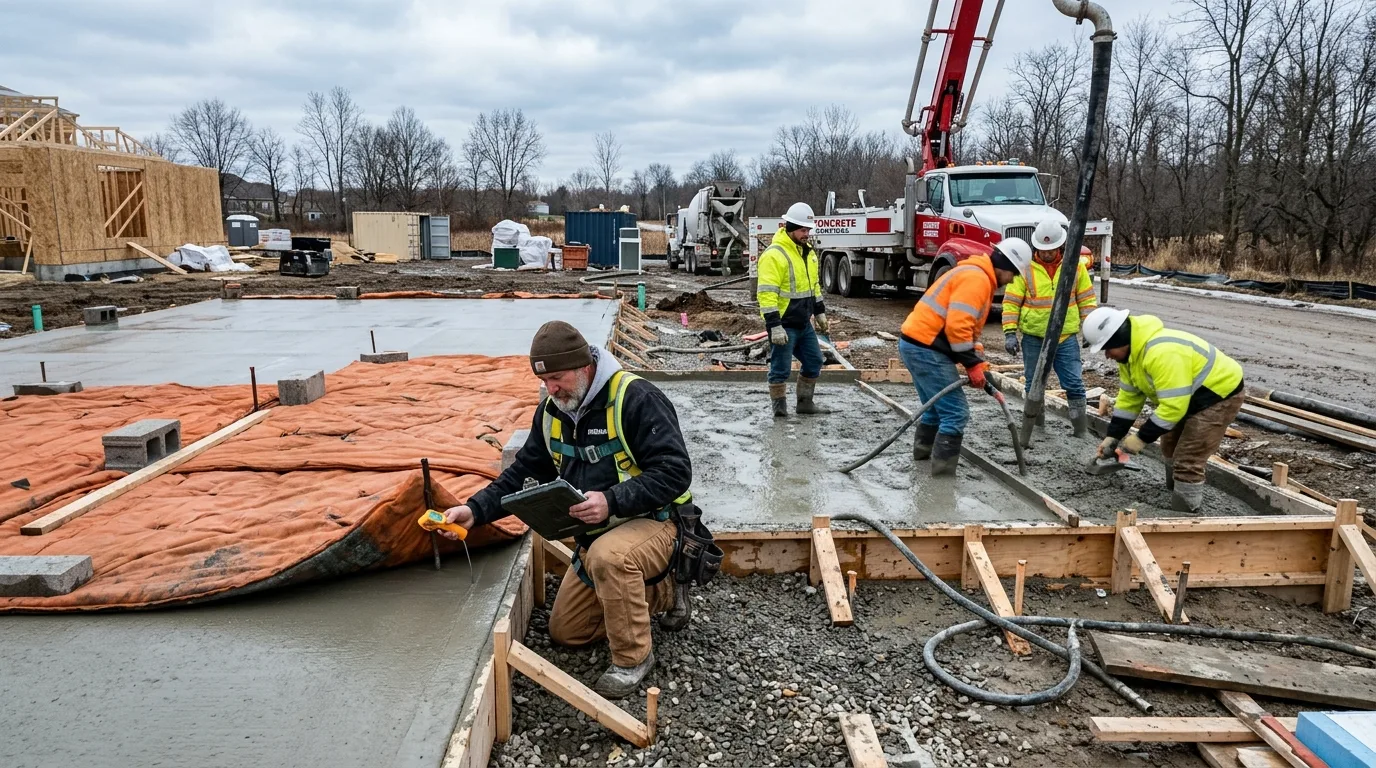
Vestavia Hills winters are mild compared to most of the country — January averages 44°F — but that doesn’t mean winter concrete pours are problem-free. Cold snaps below 32°F occur several times each December through February, and a concrete pour caught by a hard freeze before it reaches sufficient strength can suffer permanent structural damage. In this post, we cover what winter concrete installation looks like in Alabama’s conditions, what techniques allow winter pours to proceed safely, and when it makes more sense to wait for spring.
Winter Concrete Installation in Vestavia Hills — We Pour Year-Round
Cold-weather concrete done right — ask us about winter scheduling and pricing.
Why Winter Concrete in Alabama Requires Planning
Winter in Vestavia Hills creates a different set of concrete challenges than summer heat. Where summer’s risk is plastic shrinkage cracking from rapid surface moisture loss, winter’s risk is freeze damage to concrete that hasn’t yet developed adequate strength to resist it.
Fresh concrete generates heat during the hydration reaction — a phenomenon called the “heat of hydration” — which provides some protection against freezing immediately after the pour. But that heat dissipates within 12–24 hours, and concrete that hasn’t reached approximately 500 PSI compressive strength (typically achieved within 24–48 hours at 70°F) can be permanently damaged by freezing. The damage takes the form of ice crystal formation within the hydrating cement paste, which disrupts the mineral crystal network that gives concrete its strength and creates internal voids that compromise the slab’s structure.
Alabama’s occasional winter freezes — typically one to four events per winter in Vestavia Hills, with temperatures dropping below 32°F for one to three days — are serious enough to require cold-weather concrete protocols but infrequent enough that most winter concrete projects in Jefferson County can be completed successfully with proper planning.
Cold-Weather Concrete Techniques Used in Vestavia Hills
Accelerated concrete mix: Calcium chloride (typically 1–2% by cement weight) is the most common concrete mix accelerator for winter pours. It speeds the hydration reaction, generating more heat of hydration and reaching the critical 500 PSI threshold faster. Calcium chloride is effective but should not be used in post-tensioned slabs or where corrosion of embedded steel is a concern.
Heated mix water: Heating the mixing water before concrete batching raises the concrete’s initial temperature at placement. A concrete mix delivered at 60–70°F in ambient temperatures of 35–40°F provides a significant temperature buffer during the early curing period when freeze risk is highest.
Insulated curing blankets: Insulated concrete blankets retain the heat of hydration within the fresh concrete during the first 48–72 hours. Standard curing blankets (used in warm weather for moisture retention) are insufficient for cold weather — insulated blankets specifically designed for cold-weather curing are required. We deploy insulated blankets for all pours where nighttime temperatures are forecast below 40°F.
Extended curing period: Cold concrete cures more slowly than warm concrete. The industry standard is to double the curing time for every 18°F drop in temperature below 70°F. A Vestavia Hills pour at 40°F requires approximately twice as long to reach 7-day strength benchmarks as the same concrete poured at 70°F. Traffic timelines are extended accordingly.
When to Pour in Winter vs. When to Wait
Pour in winter when: Your project has a construction timeline that can’t wait for spring, you’re doing a foundation pour for new construction on a schedule, or you have flexibility in traffic timelines and the extended curing period is manageable. Winter pours in Vestavia Hills are entirely feasible between cold snaps — a sustained period of 40–55°F weather with no freeze forecast in the next 48–72 hours is adequate for most residential concrete flatwork with proper cold-weather protocols.
Wait for spring when: The forecast shows multiple freeze events in the next two weeks, you’re doing stamped concrete installation (the stamping window is severely shortened by cold temperatures), or budget concerns make cold-weather additive costs significant relative to the project scope. Waiting for March or April costs nothing and produces consistently better curing conditions.
Concrete installation to avoid in winter: Large stamped concrete projects in cold weather are high-risk. Stamped concrete requires adequate working time before initial set — cold temperatures actually help with this by slowing the set — but below 40°F, the color hardener doesn’t activate properly and stamped texture definition suffers. Spring and fall are strongly preferred for stamped concrete installation in Vestavia Hills.
Year-Round Concrete Installation in Vestavia Hills
We pour in winter with proper cold-weather protocols — driveways, foundations, patios, and retaining walls.
Practical Winter Concrete Scheduling in Vestavia Hills
Winter in Jefferson County and the Birmingham metro area — including Vestavia Hills, Hoover, and Homewood — typically runs from December through February with the coldest and most unpredictable weather in January. Scheduling concrete work for early December (before peak cold) or late February (as temperatures begin recovering) often provides adequate conditions without the most challenging freeze risks of January.
Weather monitoring is more critical in winter than in any other season. We monitor forecasts for 72 hours after planned pour dates, not just the day of the pour. A pour that goes in at 50°F on a Tuesday can be vulnerable to a freeze event on Thursday night if blankets are removed prematurely.
The concrete flatwork scheduling advantage of winter is real: contractor availability is better than in spring and summer, lead times are shorter, and project pricing is sometimes competitive as demand drops from peak season. Homeowners who can manage the cold-weather protocols and extended traffic timelines benefit from winter scheduling.
Impact on Concrete Curing Timeline in Cold Weather
At 50°F: Concrete reaches 7-day benchmark strength in approximately 10–12 days. Vehicle traffic at 10–14 days.
At 40°F: Concrete reaches 7-day benchmark strength in approximately 14–18 days. Vehicle traffic at 14–21 days.
At 32°F (with cold-weather protection): Concrete reaches 7-day benchmark strength in approximately 20–30 days. Not recommended without full cold-weather protocols and insulated enclosure.
These extended timelines are important for residential project planning — a January concrete driveway pour in Vestavia Hills means no vehicle use for two to three weeks minimum.
Frequently Asked Questions
Can concrete be poured in freezing temperatures in Vestavia Hills?
At or below 32°F, concrete pours require significant cold-weather measures: heated mix water, accelerated mix design, insulated blanket coverage from pour through 48+ hours, and extended traffic timelines. Pours during sustained below-freezing weather (multiple consecutive days below 32°F) are not recommended for residential projects unless the work can be enclosed in a heated structure during curing. Brief overnight freezes with temperatures recovering above 35°F during the day are manageable with proper insulated blanket coverage.
Does winter concrete cost more in Alabama?
Yes, modestly. Cold-weather additives (calcium chloride accelerator, heated mix water charges from the ready-mix plant), insulated curing blankets, and the labor time for additional covering and monitoring add $0.50–$2.00 per square foot to winter concrete pours. For most residential projects, this is a modest addition to the overall concrete flatwork cost. The offset is sometimes better pricing from contractors with winter availability and shorter scheduling lead times.
Is there any benefit to pouring concrete in winter in Vestavia Hills?
Paradoxically, winter temperatures between 40°F and 60°F can produce excellent concrete if properly managed. The slower hydration rate at lower temperatures actually builds stronger concrete crystal structure than rapid summer curing — if the concrete is protected from freezing. The concrete flatwork scheduling and pricing advantages (better availability, competitive pricing, shorter lead times) can make winter an attractive window for non-urgent projects where the extended traffic timelines are manageable.
Winter Concrete Pouring in Vestavia Hills — Done Right
Call (888) 376-0955 for year-round concrete services with proper cold-weather protocols for Jefferson County.
Related: